联系我们
填写以下表单联系我们

It sounds like a simple question, but it can matter in modern vehicles.
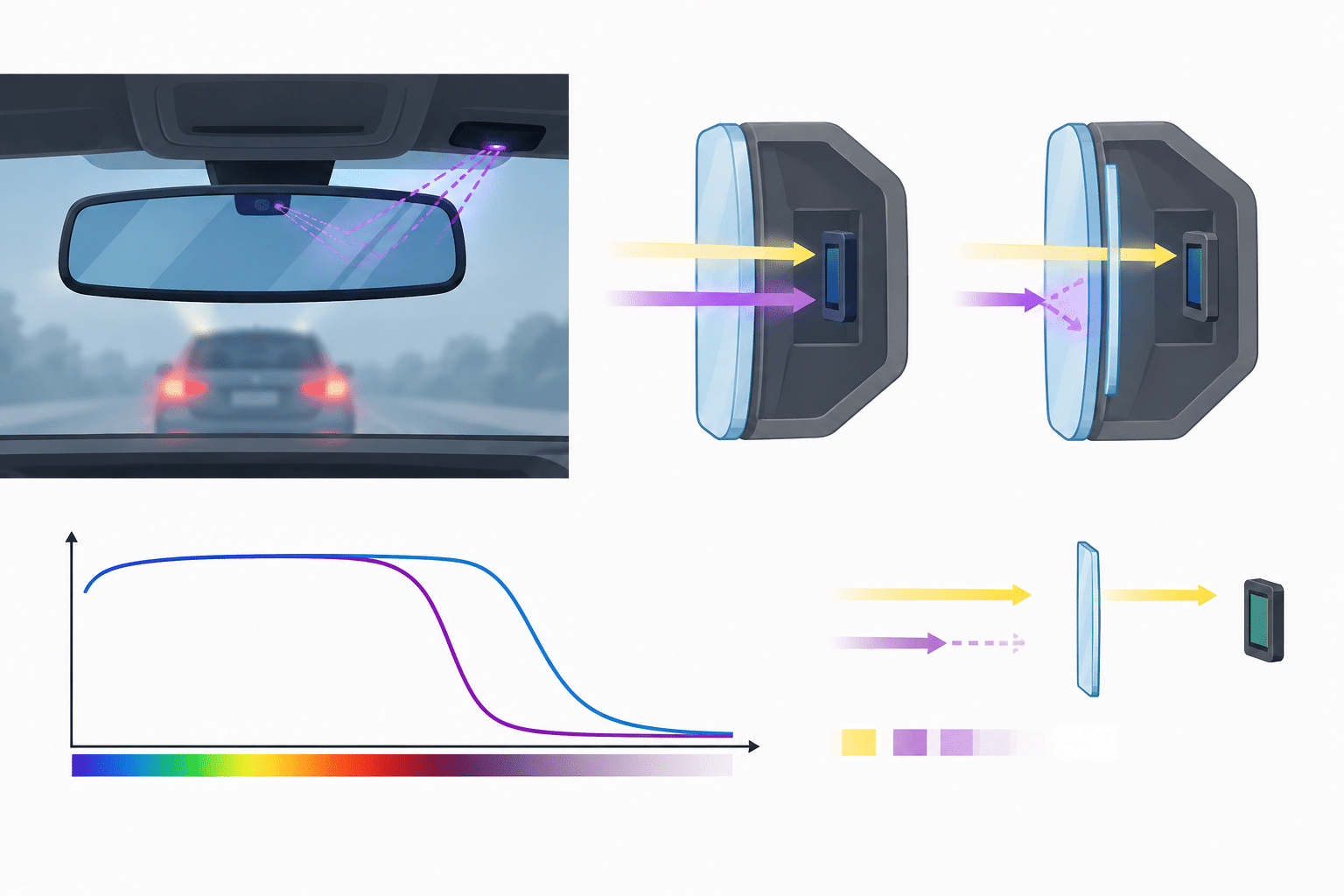
An electrochromic (EC) rearview mirror uses light sensors to decide when the mirror should darken. The sensor is mainly interested in visible light from headlights behind the vehicle.
But the sensor does not necessarily stop “seeing” at the edge of the visible spectrum.
Near-infrared (NIR) light can also reach the sensor.
That becomes more interesting as vehicles add more infrared-based sensing systems. Driver monitoring systems (DMS) and occupant monitoring systems (OMS), for example, commonly use NIR illumination around 940 nm. Automotive mirror assemblies increasingly have cameras and NIR illumination integrated into the mirror area as well.
So what happens if some of that NIR reaches the EC mirror’s glare sensor?
A photodiode doesn’t know whether a photon came from a visible headlight or an infrared LED. It simply responds according to its spectral sensitivity.
If enough NIR reaches the sensor, it can add to the signal being used to estimate glare.
That does not necessarily mean the mirror will always malfunction. The actual effect depends on the sensor’s spectral response, the intensity and wavelength of the NIR source, the optical path, and the control algorithm.
But it is a reasonable thing to check when an EC mirror behaves differently after other NIR systems are added to the vehicle.
There is already plenty of evidence that NIR and EC mirror systems are being designed together. Published automotive patents describe EC mirrors with integrated DMS cameras and 940 nm illumination, as well as optical designs intended to control transmission in the NIR range.
If the problem is unwanted NIR reaching the glare sensor, the most direct solution is also an optical one.
Put an NIR-blocking filter in front of the sensor.
The basic idea is:
Visible light → pass
Unwanted NIR → attenuate
A thin optical film can be designed to keep high transmission in the visible range while strongly reducing transmission at selected NIR wavelengths.
For example, if 940 nm is the main interference source, the filter does not need to block everything above 800 nm. It can be designed around the actual spectral response of the sensor and the NIR sources in the vehicle.
That distinction matters.
A filter that simply has “high IR blocking” may not be the right filter. What matters is the spectral curve and how it interacts with the complete sensor system.
There are different ways to block NIR.
An absorbing filter converts the absorbed optical energy into heat. A reflective filter sends much of the unwanted NIR back toward the optical environment.
Neither approach is automatically better. The choice depends on the filter construction and the geometry around the sensor. Reflected NIR can also bounce around inside a compact mirror housing, so this needs to be checked in the actual assembly.
The interesting part is that the required optical area may be tiny.
A small precision-cut film placed directly over the sensor can change the spectral input without changing the photodiode, electronics or the EC mirror itself.
Of course, making a small piece of film is the easy part.
Getting the right spectral curve, optical clarity, adhesion, dimensional accuracy and long-term stability is the harder part—especially when the component is going into an automotive product.
So, can NIR interfere with an EC rearview mirror?
Yes, it can. Whether it matters in a particular vehicle is something that should be measured, not assumed.
And sometimes the simplest way to solve an optical problem is to stop the unwanted light before the sensor ever sees it.
Please contact us, and we will respond to you shortly.
Contact UsInfrared Optics for Smart Sensing
Copyright ©2026 Visualplas Technology
